
The Best Fluffy Pancakes recipe you will fall in love with. Full of tips and tricks to help you make the best pancakes.
The Ultimate Guide to Co-Op Horror Games on PS5: Terrify Your Friends in 2026
There’s something uniquely satisfying about screaming at your TV while your best friend frantically searches for a flashlight battery in a pitch-black asylum. Co-op horror games on PS5 have transformed the genre from solitary nightmares into shared experiences where every creak, whisper, and jump scare becomes a story worth retelling. Sony’s current-gen console delivers the processing power, haptic feedback, and graphical fidelity that make these games feel more immersive than ever, whether players are hunting ghosts with thermal cameras, escaping mutated horrors, or arguing over who just wasted the last health pack.
The PS5’s library has matured significantly since launch, and 2026 brings both established franchises and fresh entries that embrace cooperative gameplay. From asymmetric multiplayer where one player becomes the monster to split-screen experiences that keep everyone on the same couch, the options span every flavor of fear. This guide breaks down the best co-op horror games available now, what’s coming soon, and how to pick the right nightmare for your group’s play style and tolerance for terror.
Key Takeaways
- Co-op horror games on PS5 leverage DualSense haptic feedback, 3D audio, and ray tracing to create immersive shared terror experiences that surpass previous console generations.
- Top PS5 co-op horror titles like Phasmophobia, Dead by Daylight, and The Dark Pictures Anthology offer distinct gameplay styles—from ghost investigation to asymmetric multiplayer to cinematic choice-driven narratives.
- Successful co-op horror sessions require clear communication strategies, role assignments, and technical preparation including headset setup, difficulty customization, and awareness of PS Plus requirements.
- When selecting a co-op horror game for your group, prioritize player count compatibility (2-4 players ideal), online vs. local co-op availability, and adjustable difficulty settings that accommodate varied skill levels.
- Upcoming 2026 releases including The Outlast Trials, A Quiet Place: The Road Ahead, and new Resident Evil multiplayer projects promise expanded cooperative horror options.
- Optimize your co-op horror experience by creating interruption-free play sessions, using PS5’s system-level party chat for coordination, maintaining 60fps performance mode for responsive gameplay, and establishing pre-game communication protocols.
Why Co-Op Horror Games Are Perfect for PS5
The PS5’s hardware capabilities transform co-op horror from a gimmick into a genuinely spine-chilling experience. The DualSense controller’s haptic feedback and adaptive triggers add tactile layers, feeling the heartbeat rhythm when a creature stalks nearby or the resistance of a jammed shotgun creates physical tension that’s impossible to replicate on other platforms. The console’s 3D audio through compatible headsets places every footstep and distant scream in spatial relationship to the player, turning sound design into a survival tool.
Near-instant loading from the SSD eliminates the immersion-breaking waits that used to punctuate horror games. When a chase sequence transitions into a new area or the game respawns players after a death, the absence of loading screens maintains tension instead of giving players time to recover their nerves. Ray tracing enhances shadow play and reflections, making environments feel unpredictable, is that movement in the window a threat or just environmental detail?
Co-op specifically benefits from the PS5’s party chat integration and Share Play features. Groups can coordinate without relying on third-party voice apps, and Share Play allows a friend to join certain single-player horror experiences remotely. The console’s ability to maintain stable frame rates during split-screen play addresses one of the biggest technical complaints from the PS4 era, where local co-op often meant sacrificing visual quality or performance.
The Best Co-Op Horror Games Available on PS5
Phasmophobia: Ghost Hunting with Friends
Phasmophobia brought ghost hunting sims to mainstream attention and remains the gold standard for investigative co-op horror. Up to four players equip EMF readers, spirit boxes, and UV lights to identify one of over 20 ghost types haunting various locations. The game’s voice recognition system lets players speak to spirits directly, calling out a ghost’s name can provoke responses, but it also increases danger during hunts.
The PS5 version includes full DualSense support, with controller vibrations mimicking EMF spikes and temperature drops. Players feel the difference between ambient activity and genuine paranormal events through haptic patterns. The game’s difficulty scales based on team competence: professional and nightmare modes remove training wheels like always-visible sanity meters and long grace periods between hunts. Communication becomes essential when a hunt begins and players must hide in silence, relying on visual cues rather than voice chat to coordinate.
Developer Kinetic Games continues updating the title with new ghost types, equipment, and maps. The recent Maple Lodge Campsite expansion added outdoor environments with different tactical considerations than the suburban houses and asylums. The game supports cross-play between PC and console, though some players report slight input delay discrepancies that can matter during time-sensitive hunts.
The Dark Pictures Anthology: Shared Terror Experiences
Supermassive Games’ Dark Pictures Anthology offers cinematic horror where player choices shape branching narratives. Each standalone entry, Man of Medan, Little Hope, House of Ashes, and The Devil in Me, supports two co-op modes: Shared Story lets two players experience the full campaign online with each controlling different characters during scenes, while Movie Night passes the controller locally between up to five players who each assume specific character roles.
The PS5 versions run at 60fps with enhanced lighting and character models, though some cutscene compression artifacts remain from the original releases. These games prioritize atmosphere and decision-making over action, QTEs and dialogue choices determine who survives to the credits. The cooperative element shines when players disagree on risky decisions: one player might choose aggressive confrontation while their partner prefers stealth, and the game accommodates both approaches with consequences that ripple through later chapters.
House of Ashes stands out for its action-horror blend set in an underground Mesopotamian temple with vampiric creatures. The game’s “Don’t Play Alone” achievement encourages co-op runs, and certain story beats land harder when players experience simultaneous but separate perspectives. The anthology format means groups can jump into any entry without prior knowledge, making it accessible for newcomers.
Dead Space Remake: Multiplayer Scares Redefined
EA Motive’s Dead Space Remake reimagines the 2008 classic with modern visuals and restructured level design that eliminates loading corridors. While the core campaign remains single-player, the game introduced a co-op survival mode post-launch that places two players in procedurally modified sections of the USG Ishimura with limited resources and escalating necromorph waves.
The mode strips away the narrative safety nets, no Stasis recharge stations or guaranteed ammo drops, and forces players into resource management dilemmas. Do you spend plasma cutter shots on basic Slashers to preserve partner health, or conserve ammo and risk a teammate going down when Brutes appear? The PS5’s haptic feedback translates Isaac’s weighted stomps and the bone-crunching resistance when severing necromorph limbs, adding physicality that enhances the already oppressive atmosphere.
Critical reception from sources like Metacritic placed the remake in the high-80s score range, with praise for visual fidelity and accessibility options that let players adjust difficulty sliders independently. The co-op mode wasn’t available at launch but arrived via a free update in late 2024, expanding the game’s longevity beyond the 15-hour campaign.
Resident Evil Village: Mercenaries Co-Op Mode
Capcom’s Resident Evil Village launched with a single-player Mercenaries mode, but the Winters’ Expansion DLC added two-player online co-op to these time-attack gauntlets. Players choose from characters like Chris Redfield, Heisenberg, and Lady Dimitrescu, each with unique abilities and weapon loadouts, to survive waves across village locations.
The co-op structure rewards coordination, combo meters build faster when players chain kills without taking damage, and certain enemy types require focused fire from both players to eliminate efficiently. Unlockable perks and weapon upgrades create progression systems that encourage repeat runs, and leaderboards track team scores globally. The PS5 version maintains steady performance during split-screen horror games PS5 sessions locally or online matches, though local co-op requires both players to have completed the base campaign.
Mercenaries mode leans more action-horror than pure survival, with abundant ammo and health drops that contrast with the main campaign’s resource scarcity. It’s an excellent entry point for groups who want horror aesthetics without punishing difficulty spikes. The expansion also included a roguelike mode called The Mercenaries: Additional Orders, which randomizes enemy spawns and item placements for added replayability.
Dead by Daylight: Asymmetric Horror Thrills
Behavior Interactive’s Dead by Daylight dominates the asymmetric horror space, pairing four survivors against one player-controlled killer. Survivors must repair generators to power exit gates while the killer hunts, hooks, and sacrifices them to a malevolent entity. The game’s roster includes original characters alongside licensed icons like Michael Myers, Pyramid Head, and the Xenomorph from Alien.
The PS5 version introduced 60fps performance and reduced queue times through cross-play with all platforms. DualSense implementation is minimal, mostly standard rumble, but the graphical upgrades improve visibility in the game’s often murky environments. The meta shifts frequently with balance patches: killer and survivor perk combinations that dominate one month might get nerfed the next, keeping the community engaged but occasionally frustrating dedicated players who build strategies around specific loadouts.
Survivors can queue as a premade group, creating opportunities for coordinated plays like flashlight saves and bodyblocking. But, the game suffers from the usual multiplayer toxicity issues, BMing (bad mannering) survivors and tunneling killers remain common complaints. Even though this, no other game captures the cat-and-mouse tension of horror movie chase sequences quite like DbD, especially when a skilled killer pressures multiple objectives simultaneously.
Back 4 Blood: Cooperative Zombie Survival
Turtle Rock Studios’ Back 4 Blood serves as the spiritual successor to Left 4 Dead, placing four players in campaign missions against zombie hordes controlled by an AI Director that dynamically adjusts difficulty. The card system differentiates it from its predecessor, players build decks of perks that modify stats, add abilities, or introduce debuffs, while the Director plays corruption cards that buff enemies or alter environmental hazards.
The PS5 version supports up to four players online and runs at 60fps with dynamic resolution scaling. The game launched with criticism for its lack of solo progression and always-online requirement, but patches addressed these issues and added a No Hope difficulty that tests even veteran teams. Runs on the hardest modes require meta deck builds and communication: a single player wandering off or triggering a hazard can cascade into a team wipe.
Post-launch DLC added new Cleaners (playable characters), campaign acts, and PvP Swarm mode refinements. The game rewards aggressive play, melee builds can dominate when supported by proper team compositions, but stumbles with occasional network desync issues that can rubber-band players during critical moments. Review aggregation platforms noted the game’s solid foundation and satisfying gunplay, though opinions split on whether the card system added depth or unnecessary complexity to the Left 4 Dead formula.
Upcoming Co-Op Horror Titles to Watch in 2026
Several anticipated releases promise to expand PS5’s co-op horror library throughout 2026. The Outlast Trials continues Red Barrels’ franchise with a Cold War-era setting and four-player co-op, though currently in Early Access on PC with a full PS5 release slated for Q2 2026. The game trades the first-person run-and-hide mechanics of previous entries for objective-based missions with limited combat abilities and social deduction elements.
A Quiet Place: The Road Ahead from Saber Interactive adapts the film franchise into a co-op survival experience where players must manage noise levels to avoid detection by sound-sensitive creatures. The DualSense’s microphone integration reportedly factors into gameplay, loud environments in the player’s real space can alert in-game monsters, though this feature can be toggled for accessibility. The game enters beta testing in spring 2026 with a projected summer launch.
Routine has been in development limbo for years but resurfaced with a confirmed 2026 release window. The lunar station setting emphasizes exploration and puzzle-solving over combat, with permadeath mechanics that reset progress upon player death. Developer Lunar Software confirmed two-player co-op support, though details on how permadeath affects team runs remain unclear. Speculation from gaming outlets like IGN suggests the game might carry out a rescue mechanic where surviving players can revive fallen teammates at specific checkpoints.
Capcom teased a new Resident Evil multiplayer project separate from RE:Verse, though whether it constitutes a full co-op campaign or another competitive mode hasn’t been confirmed. Given the success of Village’s Mercenaries co-op expansion, fans anticipate a more substantial cooperative offering. The company’s fiscal roadmap indicates a horror-adjacent release in late 2026, but official details remain scarce beyond trademark filings and investor statements.
How to Choose the Right Co-Op Horror Game for Your Group
Player Count and Party Size
Most coop horror games PS5 titles support 2-4 players, but the sweet spot varies by design. Phasmophobia scales ghost difficulty based on player count but feels most balanced with three or four investigators sharing equipment duties. Two-player runs are possible but significantly harder since players must cover more roles individually, one person handling spirit box communication while the other monitors cameras creates risky splits.
Asymmetric games like Dead by Daylight require exactly four survivors plus a killer, meaning groups of three or five must either find randoms or sit someone out. The Dark Pictures Anthology’s Movie Night mode accommodates up to five locally, making it ideal for larger gatherings where everyone gets narrative involvement without skill barriers that competitive modes impose.
Consider whether your group prefers everyone playing simultaneously or taking turns. Turn-based horror like Until Dawn (playable via PS Plus Collection) works for patient groups who enjoy backseat gaming and collective decision-making, while action-focused titles like Back 4 Blood demand constant engagement from all players.
Difficulty and Accessibility Settings
Horror games increasingly offer granular difficulty customization. Dead Space Remake includes sliders for combat difficulty, puzzle complexity, and resource availability, allowing groups to crank up enemy aggression while ensuring enough ammo to handle encounters. This prevents the frustration of being soft-locked by poor resource management while preserving challenge.
Platforms like Push Square regularly highlight accessibility features in PS5 releases. Look for games with:
- Adjustable QTE windows for players with slower reaction times
- Colorblind modes that don’t rely solely on red/green indicators
- Audio visualizers showing directional sounds for deaf or hard-of-hearing players
- Motion sickness toggles reducing camera shake and FOV adjustments
Phasmophobia’s difficulty tiers (Amateur, Intermediate, Professional, Nightmare) change ghost behavior and available equipment rather than simply increasing damage values. Amateur ghosts provide longer grace periods between hunts and more obvious evidence, while Nightmare removes UI elements entirely and randomizes evidence counts. This lets groups gradually increase challenge as they improve.
Avoid games with forced permadeath or limited saves if your group plays casually. The Dark Pictures Anthology autosaves frequently and allows chapter replays, while Dead by Daylight matches reset completely between rounds, failure in one match doesn’t affect the next.
Online vs. Local Co-Op Options
The shift toward online-only multiplayer has reduced local co-op options, but several PS5 horror games still support split-screen or same-couch play. Resident Evil Village’s Mercenaries mode allows local co-op after both players complete the campaign, and some indie titles like Obscure (via backwards compatibility) maintain classic split-screen survival.
Online co-op offers flexibility for groups with conflicting schedules but introduces technical dependencies. Check whether games require PS Plus subscriptions for online features, most do, though some free-to-play titles like certain Dead by Daylight modes bypass this requirement. Network stability matters more in horror games than players might expect: lag spikes during Phasmophobia hunts or Back 4 Blood horde events can mean the difference between clutch escapes and unfair deaths.
Share Play serves as a workaround for games lacking native co-op. One player can broadcast their screen and hand control to a remote friend for specific segments, though this works better for turn-based horror than real-time action. Input latency makes precise movement unreliable, but it suffices for narrative decision-making in games like The Dark Pictures Anthology.
Tips for Maximizing Your Co-Op Horror Experience
Communication Strategies for Survival
Effective communication separates successful horror teams from corpses. Establish callout systems before starting, agree on shorthand for common threats (“Slasher left,” “Ghost hunting,” “Need ammo”) rather than panicked screaming. Panic is inevitable, but structured communication under pressure saves runs.
In Phasmophobia, assign roles pre-investigation: one player monitors the truck’s camera feeds, one handles the spirit box, one tracks EMF and temperature, and one photographs evidence. Rotating roles between contracts keeps gameplay fresh and ensures everyone understands each responsibility. During hunts, use proximity chat strategically, the game’s voice recognition means talking can reveal hiding spots to the ghost.
Back 4 Blood teams should communicate deck builds during loadout to ensure balanced compositions. Running four DPS builds without support or tank cards creates resource depletion issues on higher difficulties. Share information about corruption cards as they appear, knowing a “Fog” card is active changes movement strategies and positioning.
For asymmetric games like Dead by Daylight, survivors should call out killer location, perks once identified, and generator progress. Avoid over-communication that drowns critical info: “Wraith just uncloaked by the shack” is useful, but constant narration of every action creates noise that obscures urgent callouts.
Setting the Right Atmosphere
Horror games live and die by atmosphere, and co-op sessions require deliberate setup to maximize immersion. Lighting matters, dim room lights enough to enhance screen visibility without causing eye strain. Completely dark rooms sound ideal but often result in players checking phones during tense moments because they can’t stay focused without environmental anchors.
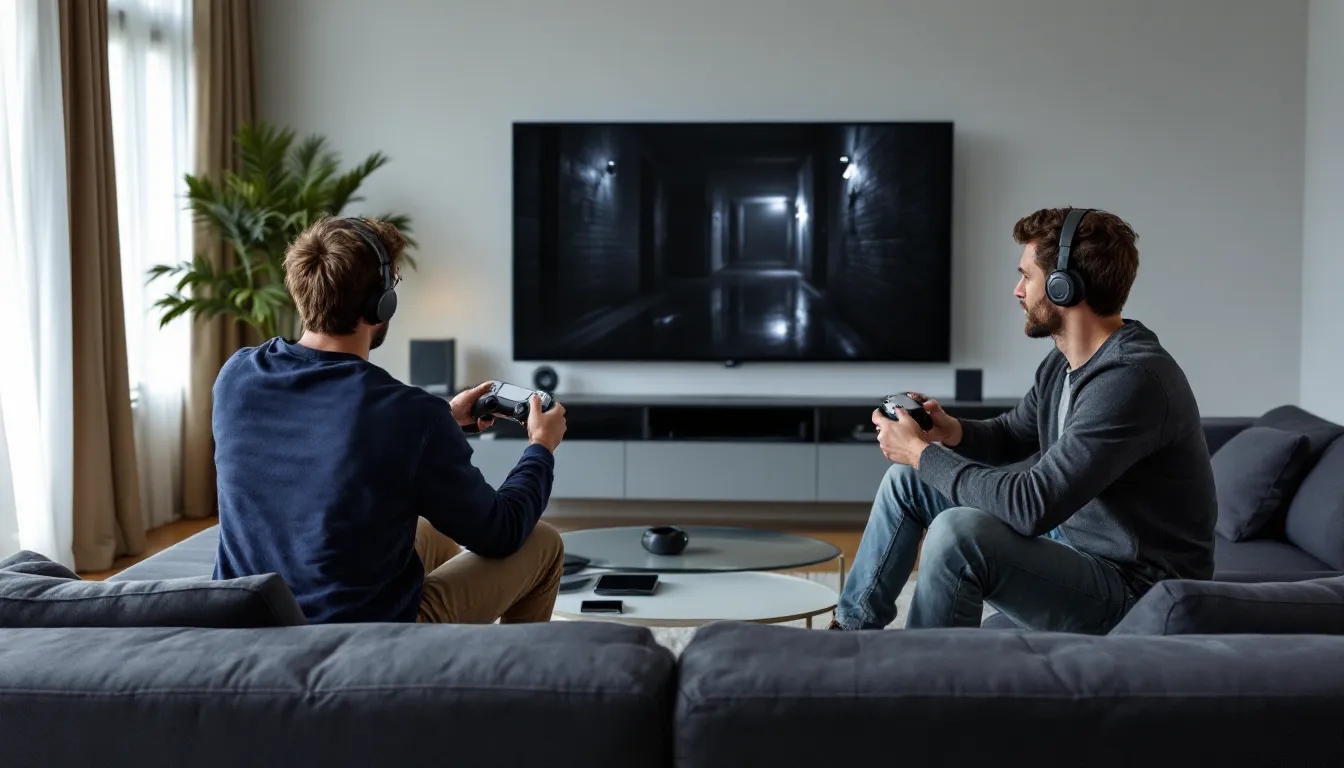
Use headsets rather than TV speakers when possible. The PS5’s 3D audio through compatible headsets provides directional information that stereo TV speakers can’t replicate. In Dead Space Remake, hearing necromorph vents open behind the player’s position creates spatial awareness that’s impossible with standard audio setups.
Schedule sessions when interruptions are unlikely. Few things kill tension faster than pausing mid-hunt because someone’s food delivery arrived. Horror games demand sustained focus, two-hour uninterrupted blocks work better than scattered 30-minute sessions.
Consider synchronized snack/break schedules during natural lulls rather than mid-mission. The Dark Pictures Anthology structures chapters with defined endpoints perfect for breaks. Phasmophobia contracts take 10-20 minutes, creating natural stopping points between investigations.
Some groups enhance immersion with themed snacks or ambient lighting (smart bulbs synced to in-game events), but avoid gimmicks that distract from gameplay. The goal is removing barriers to immersion, not creating elaborate setups that become the focus over the actual game.
Technical Considerations for PS5 Co-Op Horror Gaming
PS Plus Requirements and Online Features
Most online co-op horror games require an active PlayStation Plus subscription for multiplayer access. Both the base PS Plus Essential tier and higher Premium/Extra tiers enable online play, but Premium subscribers gain access to a catalog that includes some co-op horror titles like the Resident Evil franchise entries and various indie horror games.
Verify whether games support cross-play if your group spans multiple platforms. Phasmophobia and Dead by Daylight both enable cross-play between PS5, PC, and Xbox, expanding matchmaking pools and allowing platform-agnostic friend groups to play together. Some games default to platform-only matchmaking with cross-play as an opt-in setting, check menus before assuming connectivity issues.
Party chat through PS5’s system-level features works across all games, but some titles include native voice chat with proximity or radio mechanics. Phasmophobia’s proximity chat adds gameplay value that external party chat eliminates, so groups should use in-game audio even though the convenience of system-level alternatives. Create a party for pre-game coordination, then switch to in-game voice when starting.
Cloud saves through PS Plus prevent progress loss but require manual uploads in some titles. Horror games with permadeath or harsh fail states might tempt save-scumming, though this obviously defeats intended design. For games supporting campaign progress across sessions, verify cloud sync works properly, corrupted saves after 10+ hour co-op runs qualify as their own horror genre.
Performance and Graphics Enhancements
The PS5 offers performance modes in most titles, letting players prioritize frame rate or visual fidelity. Horror games generally benefit more from stable frame rates than marginal graphical improvements, 60fps response time matters when dodging attacks or timing QTEs. Games like Resident Evil Village and Dead Space Remake include both modes: performance mode maintains 60fps at dynamic 4K, while quality mode targets native 4K at 30fps.
Ray tracing in horror games enhances shadow behavior and reflection accuracy, creating atmospheric improvements that justify performance costs in specific titles. Dead Space Remake’s ray-traced reflections on the Ishimura’s metallic surfaces add environmental storytelling details, while Resident Evil Village uses ray tracing for more convincing candlelight and fireplace illumination.
Monitor response time and input lag become relevant factors in competitive asymmetric horror. Dead by Daylight players notice latency differences between displays, TV game modes reduce processing lag, but dedicated gaming monitors provide faster response. For cooperative PvE games, display latency matters less than consistent frame pacing and audio sync.
HDR implementation varies wildly across horror titles. Proper HDR elevates darkness without crushing shadow detail, but poorly calibrated HDR washes out colors and reduces visibility. Test HDR settings using in-game calibration tools, most PS5 horror games include brightness and HDR sliders during first launch. If dark areas become completely black or bright areas bloom excessively, consider disabling HDR rather than fighting suboptimal implementation.
Conclusion
Co-op horror on PS5 delivers shared nightmares that transform solitary scares into memorable group experiences. The console’s technical capabilities, haptic feedback that translates environmental dread, 3D audio that positions threats spatially, and hardware that maintains performance during intense sequences, provide the foundation for horror games to reach new immersive heights.
The genre’s variety ensures groups can find their preferred flavor of fear, whether that’s investigative ghost hunting in Phasmophobia, cinematic decision-making in The Dark Pictures Anthology, or frenetic zombie survival in Back 4 Blood. Upcoming releases promise to expand options further, with developers increasingly recognizing that horror shared dilutes individual fear but amplifies memorable moments.
Choosing the right game requires honest assessment of group dynamics, player count preferences, skill levels, tolerance for difficulty, and whether schedules align for online sessions or favor local co-op. Technical considerations like PS Plus requirements and performance modes matter, but the core question remains simple: what kind of scares does your group want to experience together?
The answers are out there, waiting in darkened corridors, abandoned space stations, and haunted asylums. Grab some friends, adjust those headset volumes, and prepare to scream in harmony. Just remember to assign someone to monitor the flashlight batteries.